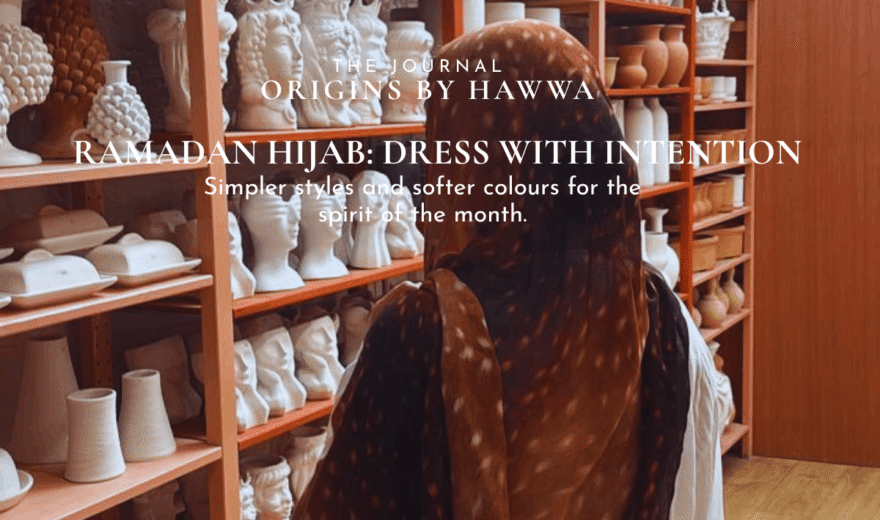
During Ramadan, many women choose simpler, more understated hijab styles and modest colours that reflect the spirit of the month. Breathable fabrics like modal suit the longer days spent fasting. Some women also use Ramadan as a chance to revisit their intention behind covering in the first place, treating the month as a form of renewal rather than routine.
Ramadan reshapes almost everything about how a day moves. It changes when you eat, when you pray, how much energy you have by late afternoon, and how much time you spend at the mosque in the evenings. It makes sense that it reshapes how many women think about their hijab too. This isn’t about a strict Ramadan-specific dress code there is no requirement to dress differently during the month. It’s more that the month brings people back to first principles, and for many, that includes thinking again about why they cover, not just how.
Why comfort matters more during a fast
Fasting changes the practical demands on your clothing more than most people expect going in. Without food or water from dawn to sunset, the body runs warmer in some ways and more fatigued in others. Heavier or restrictive fabrics can feel far more taxing by the ninth or tenth hour of a fast than they would on an ordinary day.
This is one of the most practical reasons breathable fabrics come up so often in conversations about Ramadan dressing. Modal, for instance, is spun from beech tree fibres and has a natural moisture-wicking quality. Many women find it noticeably more comfortable during long fasting days, particularly for hijabs worn from early Fajr prayers through to Taraweeh at night.
If you’re new to modal, our guide to washing modal hijabs covers how to keep it soft through frequent Ramadan wear.
Colour choices during Ramadan often shift too, though this is closer to a common preference than a rule. Many women gravitate toward quieter, more grounded tones for daily wear — a Sage Garden or a soft neutral, rather than something bold and save brighter colours for Eid itself.
The shift in palette marks the change between the month of restraint and the celebration that follows it. Nothing in Islamic teaching requires subdued colour during Ramadan specifically, but the pattern is common enough to be worth naming.
For the Eid side of that transition, picks up where this one leaves off.
Ramadan as a return to intention
Niyyah, or intention, sits at the centre of how many scholars describe the purpose of hijab in the first place. It’s not a garment worn out of habit, but an act carried out consciously, for the sake of Allah.
Scholars often describe Ramadan as the month of return, and for many women, that return includes their hijab. A hijab worn every day can become something you put on without thinking, the same way any daily habit loses its original meaning through repetition.
Ramadan’s emphasis on self-examination and renewal gives many women a natural moment to ask again why they cover, rather than simply continuing because it’s what they always do. Our piece on what niyyah means in Islam goes deeper into this idea if you want to sit with it further.
This doesn’t require a dramatic wardrobe change. It can be as simple as pausing before putting on your hijab each morning and naming your intention silently, the way many women already pause before prayer. Some women use the month to experiment with simpler styles specifically so the hijab draws less attention, in keeping with the broader spirit of restraint that runs through fasting, reduced consumption, and quieter routines during Ramadan.
Putting it into practice
For daily wear during the month, reach for a soft modal hijab in an understated shade. It’s breathable enough for long fasting hours and simple enough to wrap quickly before Fajr without much adjustment. Try a no-pin, single-layer wrap for the early hours — it’s less to manage on limited sleep and an empty stomach.
For Taraweeh and evening prayers at the mosque, choose a more secure style that won’t need readjusting through extended standing and prostration. Pair an underscarf with a simple wrap-and-tuck finish; it holds well through a longer prayer without requiring a mirror check.
If you’re using the month as a moment of renewal, set aside a specific colour or piece a hijab in Midnight Ink, for example — to wear only during Ramadan. Putting it on each morning becomes a small, deliberate marker of the month rather than blending into your everyday rotation.
Some women extend this into Eid itself, switching into a brighter colour on the morning of Eid prayer to visibly mark the transition from fasting into celebration.
Common questions
Is there a specific hijab style recommended for Ramadan? No particular style is required. Most women share two priorities: comfort for long fasting days and simplicity that reflects the month’s spirit of restraint. Both are preference, not obligation.
Should I wear different hijabs for Taraweeh than for daytime? Many women do, mainly for practical reasons. Taraweeh involves extended standing, bowing, and prostration, so a style that stays secure through movement suits evening prayers better than one that needs frequent readjusting.
Does the fabric of my hijab actually matter for fasting comfort? Yes, more than most people expect. Breathable fabrics like modal help regulate temperature during long fasting hours, particularly for hijabs worn continuously from Fajr to Isha. Heavier or less breathable fabrics feel considerably more uncomfortable by the later hours of a fast. For broader guidance on the spiritual dimensions of the month, IslamicRelief’s Ramadan resources offer additional context beyond styling.