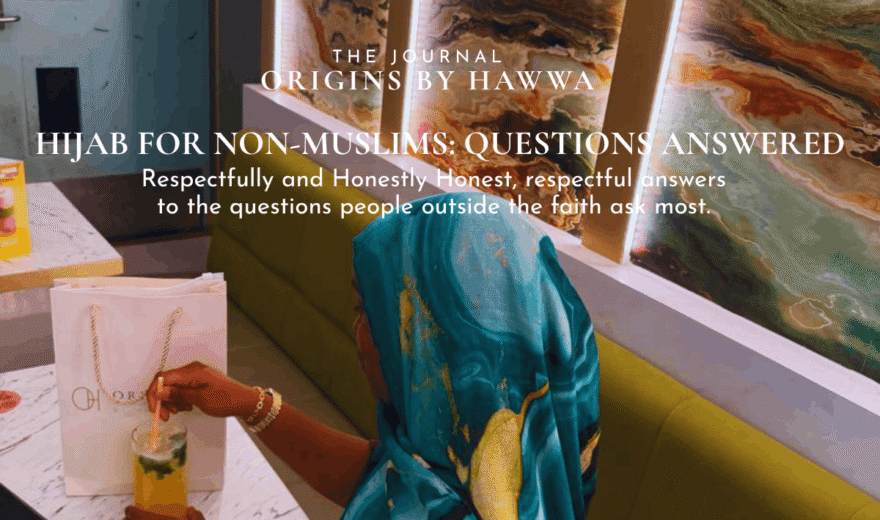
Hijab for non-Muslims raises the same few questions again and again. Curiosity about it is not disrespect. That has to be said first. Most people who wonder about hijab are not trying to interrogate anyone. They are simply looking at something unfamiliar. They are doing what people do with unfamiliar things: they ask. The problem was never the question. Most answers people get are either too defensive to be honest, or too simple to be true. So here is the honest version of hijab for non-Muslims, covering the questions we hear most.
Is hijab required, and are women forced to wear it?
Islamic teaching holds that hijab is a religious obligation for Muslim women from puberty onward. That is one fact. Whether every individual woman experiences it as freely chosen is a separate question entirely. Both things are true at the same time. That is exactly where most explanations fall apart. People want one clean answer. There isn’t one.
Millions of women choose hijab deliberately. They describe it in terms of empowerment and identity. They would tell you plainly that nobody made them do anything. That is real. It is also real that in some families, and in some countries, coercion happens. Pretending otherwise would be its own kind of dishonesty. Neither picture alone tells the truth. A story that makes hijab universally joyful erases the women living under real pressure. A story that makes it universally forced erases the women who chose it and never looked back. The honest answer sits inside that tension. It doesn’t resolve it, because resolving it would mean lying in one direction or the other.
Does hijab get uncomfortably hot, and how do women manage it?
This one is fair, and it deserves a straight, practical answer rather than a defensive one. Heat depends almost entirely on fabric, not on the concept of hijab itself. Heavy or synthetic material traps heat the way any heavy fabric would on anyone in summer. That is exactly why fabric choice matters so much in this industry. Modal, for instance, wicks moisture naturally. It performs noticeably better in heat than the heavier alternatives it’s often compared against. Our summer hijab guide goes further into the specific fabric and styling choices that make the difference.
Women who wear hijab daily build a seasonal wardrobe. They do it the same way anyone adjusts what they wear for the weather. It’s a real, practical choice, worked out through experience. It isn’t a silent hardship nobody talks about.
How should you ask about hijab respectfully?
Ask her directly. Not someone standing next to her. Not a colleague who happens to know her. Her. Most Muslim women would rather answer a genuine question themselves. They’d rather do that than have someone quietly decide the answer on her behalf and never actually check. That habit, deciding what a woman feels without asking her, turns a question into an assumption.
Watch the framing you lead with. Opening straight into whether she’s forced to wear it assumes the answer before she’s said a word. That assumption is what makes an otherwise fine question feel loaded. A useful check: would you ask this about another visible religious practice, worded the same way? If it would feel intrusive there, it’s intrusive here too. That test strips the question down to what it really is.
Common questions about hijab for non-Muslims
Is it offensive to ask a Muslim woman about her hijab? Not inherently. A real, curious question, asked plainly, is usually welcomed. What matters is the framing. Specifically, does the question already assume an answer before she’s given one.
Do all Muslim women wear hijab? No. Practice varies across individuals, families, and countries, shaped by personal choice, culture, and context. Women who wear it and women who don’t exist within the same faith community. Neither one is the exception that proves a rule.
Can non-Muslim women wear hijab out of respect, for example when visiting a mosque? Yes, and this is standard practice, not appropriation. Many mosques provide a scarf for visitors, or simply ask that one be brought along. Wearing it in that setting is understood as a gesture of respect for the space. For deeper scholarly context on hijab specifically, Yaqeen Institute’s research offers more than this overview can.